
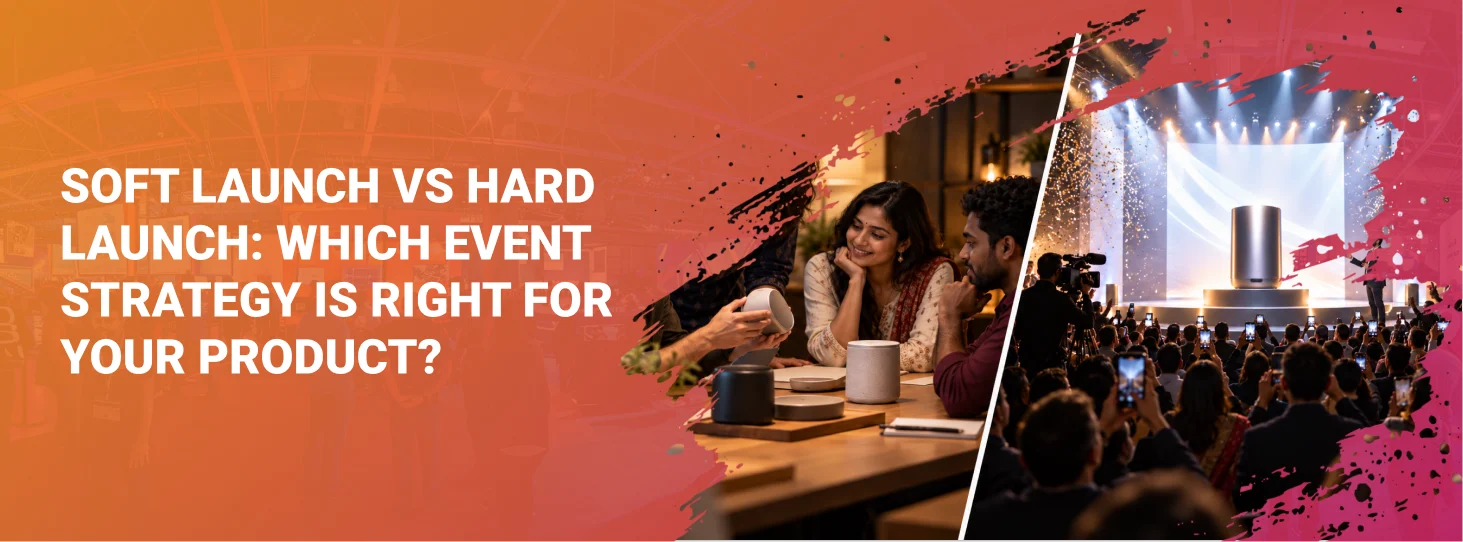
Soft Launch vs Hard Launch: Which Event Strategy Is Right for Your Product?
Say you’ve spent eight months on a product. Money’s gone into it, weekends too. Launch day comes and hardly anyone turns up. The sales figure is a fraction of what you’d penciled in.
That hurts and it happens more than people admit. A good product isn’t enough on its own. Customers must hear about it, see why it’s relevant to them, and care enough to try it. How you introduce it often decides all three.
There are two broad ways to do that. Some businesses start small, hand the product to a few people and listen to what they say. Others go loud from the first day, with an event, ads, influencers, the lot. Those are the soft launch and the hard launch.
What Is a Soft Launch?
Think of a new restaurant. Before the proper opening, the owner invites family, friends and a few regulars for an evening. They eat, and then they say what they thought: the food, the service, the prices. If the dal is too salty or the wait is too long there’s still time to sort it out.
A soft launch is the same idea. You release the product to a limited group first, see how they react, and fix what’s broken before the wider market gets a look.
Suppose you’ve built an app for tracking daily expenses. You think it’s easy to use, but you’ve looked at it for a year so your opinion isn’t worth much anymore. You give it to fifty people. A few love the monthly reports. Several can’t figure out the dashboard. One finds a crash on a particular phone that never showed up in testing. You’d much rather hear all that from fifty people than from fifty thousand.
That’s the real value here, you’re allowed to get things wrong while it’s still cheap to do so.
Why Businesses Choose a Soft Launch
The first reason is cost. Not every product needs a stage, a celebrity and a hoarding campaign. A soft launch can be a small demo, a private preview or an online session, which matters a lot to startups and small businesses testing an idea.
You also get time to change things. If the first buyers of your skincare cream struggle to open the jar, you can redesign the lid before thousands more are made. It’s the same with software, food and clothing.
And your own team gets practice. They find out what customers really ask, rehearse their demos on real people, and see where support falls short. By the main launch, very little will catch them off guard.
When a Soft Launch Makes Sense
It fits when you still have open questions. Startups, apps, software, subscription services and new food or beauty products are the usual candidates.
An accounting software company might invite 30 business owners to use the product before it goes public. What those owners complain about would shape the final version.
One warning though. A soft launch needs a purpose. Inviting a few people and calling it a launch doesn’t count. Decide what you want to learn, ask specific questions and be ready to act on the answers.
What Is a Hard Launch?
Now picture a clothing brand releasing its festive collection. Teaser posts go up a few weeks ahead. Influencers get invited to a preview at a nicely done venue. By launch day people are already sharing photos and asking what things cost.
That’s a hard launch, a public, high-visibility introduction backed by a proper campaign. It can include a launch event, advertising, influencer tie-ups, press coverage and social media promotion. A soft launch is mostly about learning. A hard launch is about getting noticed and getting people to buy or try.
Why Businesses Choose a Hard Launch
The biggest advantage of a hard launch is reach. When the product is ready, going loud all at once gets the word out fast, whether through social media, paid ads, partners or events.
It also creates a bit of buzz. People like a proper reveal, and a live demo or a well-run presentation gives them something to talk about long after they’ve left.
Then there are the sales. A strong launch can send visitors to your site, bring in questions from serious buyers and land your first orders. How much of that you actually see depends on your product, pricing, targeting and execution, but a launch lets you aim all your effort at one moment.
Last, there’s the first impression. A well-organised event, with tidy displays, clear presentations and guests who feel looked after, shows people you’re serious about your business. You don’t need the fanciest venue in town. It just has to feel thoughtful and fit your brand.
When a Hard Launch Makes Sense
Go big when the product is ready, you know who you’re selling to, and your team can handle the response. A well-known electronics brand releasing a new phone is the classic case: a media event, tech influencers, and ads running before sales open.
Don’t copy that just because competitors do. If the product still has serious problems, or you can’t cope with a sudden rush of orders and enquiries, spending heavily on promotion won’t save it. Attention only helps if the product holds up when people try it.
Soft Launch vs Hard Launch: The Differences
| Factor | Soft Launch | Hard Launch |
|---|---|---|
| Audience | Small, selected group | Wider target audience |
| Main goal | Test and improve the product | Build awareness and generate interest |
| Budget | Usually lower | Often higher |
| Marketing | Limited and targeted | Wider promotional campaigns |
| Feedback | Collected before wider release | Collected during and after launch |
| Public exposure | Limited at first | High from the start |
| Best suited for | Products that need testing | Market-ready products |
How Product Launch Event Management Helps
Planning a launch sounds fun until you start. There’s a venue to book, invitations to send, displays to build, vendors to chase and a schedule to hold together. Bigger events add lighting, sound, guest registration and media handling. Meanwhile your business still needs running.
Professional product launch event management brings those pieces together and keeps the event tied to what you set out to achieve.
Planning a Soft Launch Event
Keep it simple. If the goal is feedback a small setting usually works better than a big one.
Say you’re launching a business application. Invite a handful of business owners to a private demo, in your office or on a video call. Your team shows how it works, lets them try it and answers questions. Then leave time for an open chat about what worked and what didn’t. The main thing is giving people long enough with the product to form a real opinion.
Planning a Hard Launch Event
A hard launch has more people, higher expectations and a lot more that can go wrong.
Take a premium watch collection. You’d want a striking venue, carefully staged displays, good lighting and a presentation. The guest list of media, influencers and likely buyers are just as important. The sound has to work, the reveal has to happen on time, and guests should know where to go and what comes next.
An event team deals with the vendors, runs the schedule and plans for the things that inevitably go wrong. That leaves you free to talk to guests and build relationships, rather than panicking over a dead microphone.
Can You Use Both for the Same Product?
You can, and plenty of businesses do.
Take a fitness app. The company releases it to a small group first. Within a few weeks the feedback shows that some workout instructions are confusing and a couple of features need work. The developers fix those and test again. Only then does the company go public, with social media campaigns, influencer partnerships and a launch event.
The soft launch taught them about their users and the hard launch brought in a far bigger audience. It costs extra time and planning, but if you need feedback before spending heavily on promotion, a two stage launch is a good way to cut the risk.
How to Choose the Right Strategy
Still confused about which launch strategy to choose? Don’t worry. Just think about a few simple things before making your decision.
Is your product ready? If you still need to test some features or you are not sure what customers will think then a soft launch is a better choice. It gives you time to make changes before introducing the product to more people.
Do you know your audience? If you already know who your customers are and how to reach them then a hard launch can work well. It helps you spread the word and get more people interested in your product.
Can your team handle the demand? A big launch can bring lots of orders and enquiries at once. So before planning a major event make sure your team is ready to manage everything without creating problems for customers.
What do you want to achieve? If your main aim is to test the product and get honest feedback then start small. But if you want more people to know about your product then a hard launch may be the right choice. You can also start with a soft launch and plan a bigger event later.
In the end there is no single strategy that works for every business. Choose the one that fits your product and your budget. Think about your customers and what stage your business is at right now.
Conclusion
Launching a new product is exciting but it also comes with a lot of responsibility. You want people to notice your product and understand why it is worth trying. But for that to happen you need proper planning and the right approach.
A soft launch helps you understand your customers and improve your product before reaching a wider audience. A hard launch helps you create excitement and introduce your product to more people. Both can work well if you choose the right one for your business.
Planning to launch your next product? Get in touch with Dream Events today. Let’s plan an event that brings your brand closer to the people you want to reach.
At Dream Events we understand that every product has its own story. Whether you are planning a small product preview or a big launch event our team can help you organise everything and present your product in the right way.
Frequently Asked Questions (FAQs)